The First 20 Minutes of Arrival (2016) Doesn’t Make Sense
I was reminded of the movie Arrival last night while having dinner with some linguists. It’s a great movie to hate, but while we were talking about it, I mentioned that the opening scene where Adams’s character is recruited does not make sense. I could only half remember what my issue with the movie was since it had been a few years since I first noticed it, but none of the other linguists knew what I was getting at. So last night I rewatched the first act, and I can now explain and log for posterity my pedantic issue with the first 20 minutes of Arrival (2016). I humbly submit this as a novel contribution to the long legacy of linguists hating on that movie.
The opening scene has Forest Whitaker explaining the translation job to Amy Adams. She says she needs to be present to translate. He says he can’t do that, that he’s going to Danvers (another linguist) at Berkeley instead, and that his offer is rescinded once he leaves the office. Before he leaves, Adams says, “Before you commit to [Danvers], ask him the Sanskrit word for ‘war’ and its translation.”
Then the immediate next scene is Whitaker, having already visited Danvers, coming to Adams’s home. He says the word is “gavisti,” and that Danvers translated it as “an argument.” He then asks Adams, “What do you say it means?” She says, “a desire for more cows,” at which point he says, “Pack your bags.” The clear implication is that he chooses her because her translation is more accurate, or more faithful, or better in some way. But the thing is he can’t possibly know that, since he doesn’t know Sanskrit. This was Adams’s challenge to Danvers after all. Nevertheless, the editing treats this exchange like the moment Whitaker makes his decision, as if he could adjudicate the two competing translations of a language he—again—doesn’t know. Watch the scene and tell me if that isn’t the way you read it.
Because I was curious, I read the screenplay, and the wording of the “gavisti” beat is slightly different in a way that makes more sense.
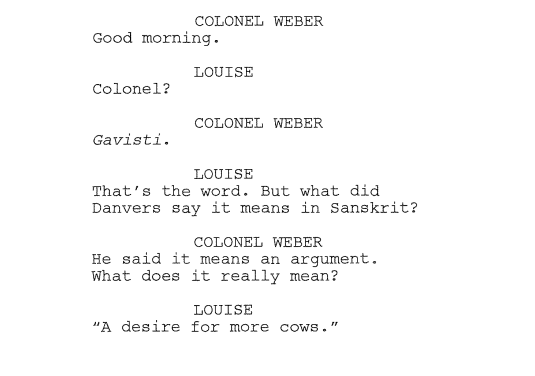
In the screenplay, Whitaker’s character says, “What does it really mean?” In the film, he says, “What do you say it means?” It’s a small wording change, but it has a totally different pragmatic force. The screenplay line implies skepticism of Danvers from the outset and deference to Adams, like he already thinks Danvers’s answer is inadequate and is asking her for the deeper meaning behind it. Why he’s skeptical of Danvers before hearing Adams’s translation is left to interpretation, and I’m fine with that, since she was his first choice in the opening scene anyway. The film’s version, though, reads like he can judge the quality of a Sanskrit translation—which wouldn’t make any sense—and that’s the kind of thing a better director (or editor) would have caught.